

AI search optimization for SaaS (GEO, AEO)
Buyers build the shortlist with AI before they talk to sales. Are you on it?
The first touchpoint is no longer your website or a review site. It is an assistant naming three tools - and the demo requests go to those three.
We asked both assistants what a small business owner would ask.
Asked: What is the best CRM for a small business?
For most small businesses, I’d put HubSpot, Pipedrive, and Zoho CRM on the shortlist. There isn’t one universally best CRM—the right choice depends mostly on whether you prioritize simplicity, sales-pipeline management, or breadth/customization.
| CRM | Best fit | Starting point | Main strength |
|---|---|---|---|
| HubSpot CRM | Most small businesses | Free; paid Sales Hub from about $15/seat/mo on current offers | Easy to start, broad sales/marketing/service ecosystem |
| Pipedrive | Sales-focused businesses | About $14/user/mo annually | Excellent visual sales pipeline |
| Zoho CRM | Budget-conscious businesses needing customization | About $14/user/mo annually | Lots of functionality for the price |
| Freshsales | Small teams wanting inexpensive sales automation | About $9/user/mo annually | Built-in sales tools and AI features |
5 brands named
- HubSpot
- Pipedrive
- Zoho CRM
- Freshsales
- monday.com
Asked: What is the best CRM for a small business?
There's no single "best" CRM for every small business — the right choice depends on your budget, team size, and what you need it to do (sales tracking, marketing, customer service, or all three). That said, a few consistently stand out in 2026 reviews:
HubSpot CRM – Great starting point if you're on a budget or just starting out. It's an all-in-one sales, marketing, and service platform with a genuinely usable free tier that connects pipeline deals to contact records, email templates, and a Chrome extension that surfaces CRM data inside Gmail, with the free plan covering pipelines, contact management, task reminders, and light automation for up to two users. One caveat: it's a great starting point with a free plan and clean UI, but as your business grows, features and contacts can add up to high costs and complexity.
7 brands named
- HubSpot CRM
- Salesforce
- Zoho CRM
- Zoho Bigin
- Freshsales
- NetHunt CRM
- Pipedrive
ChatGPT named 5 brands. Claude named 7. Is yours one of them?
A buyer who asks this never opens a results page. They get a short list, pick from it, and the brands that were not on it never had a chance.
The list is short
An answer names a handful of brands, not ten blue links. Being the eleventh result used to be visible. Being the eleventh brand is invisible.
Each assistant reads differently
ChatGPT and Claude above answered the same question with different brands, because they read different sources. Winning one does not win the other.
It changes every week
Answers move as models update and new pages get cited. A single audit tells you where you stood once; it does not tell you when you dropped out.
Measure it, then put an agent on it
It does the work, not just the report
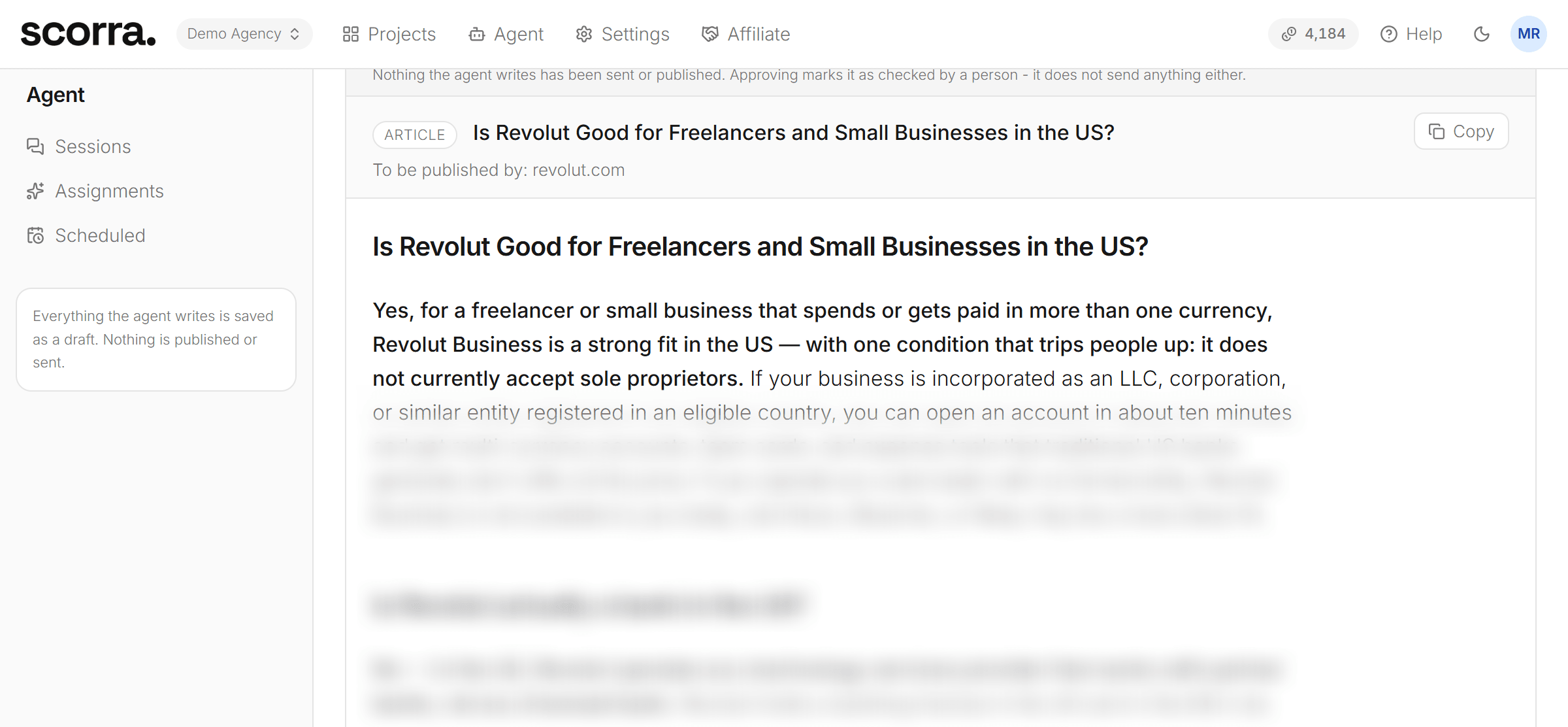
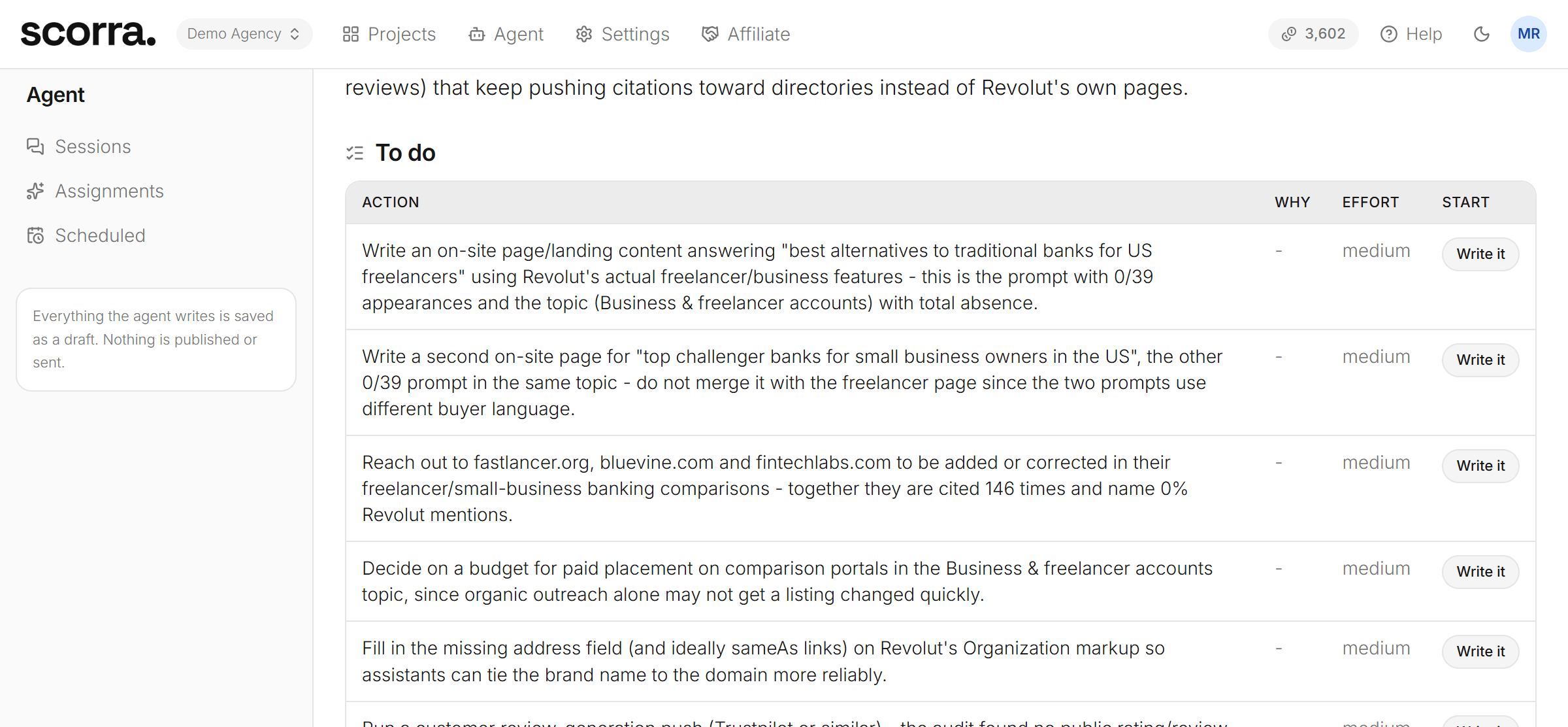
The agent reads what the assistants said about your category, finds the questions you lose and the pages they cite instead of you - and then writes. Briefs and full drafts for your site, a pitch to the publications that keep getting cited, a plan with the effort each step takes.
- Writes the page that answers the question you lose - every number with its source
- Names the exact sites assistants read and never mention you on
- Turns an analysis into a to-do list you can start with one click
- Nothing is published or sent without you
Ask it from Claude or ChatGPT
Connect Scorra once and ask about your visibility from the assistant you already use. The answer comes from your own measurements, not from a guess.
Included from Growth up. Each tool call uses 1 credit.
Learn more →
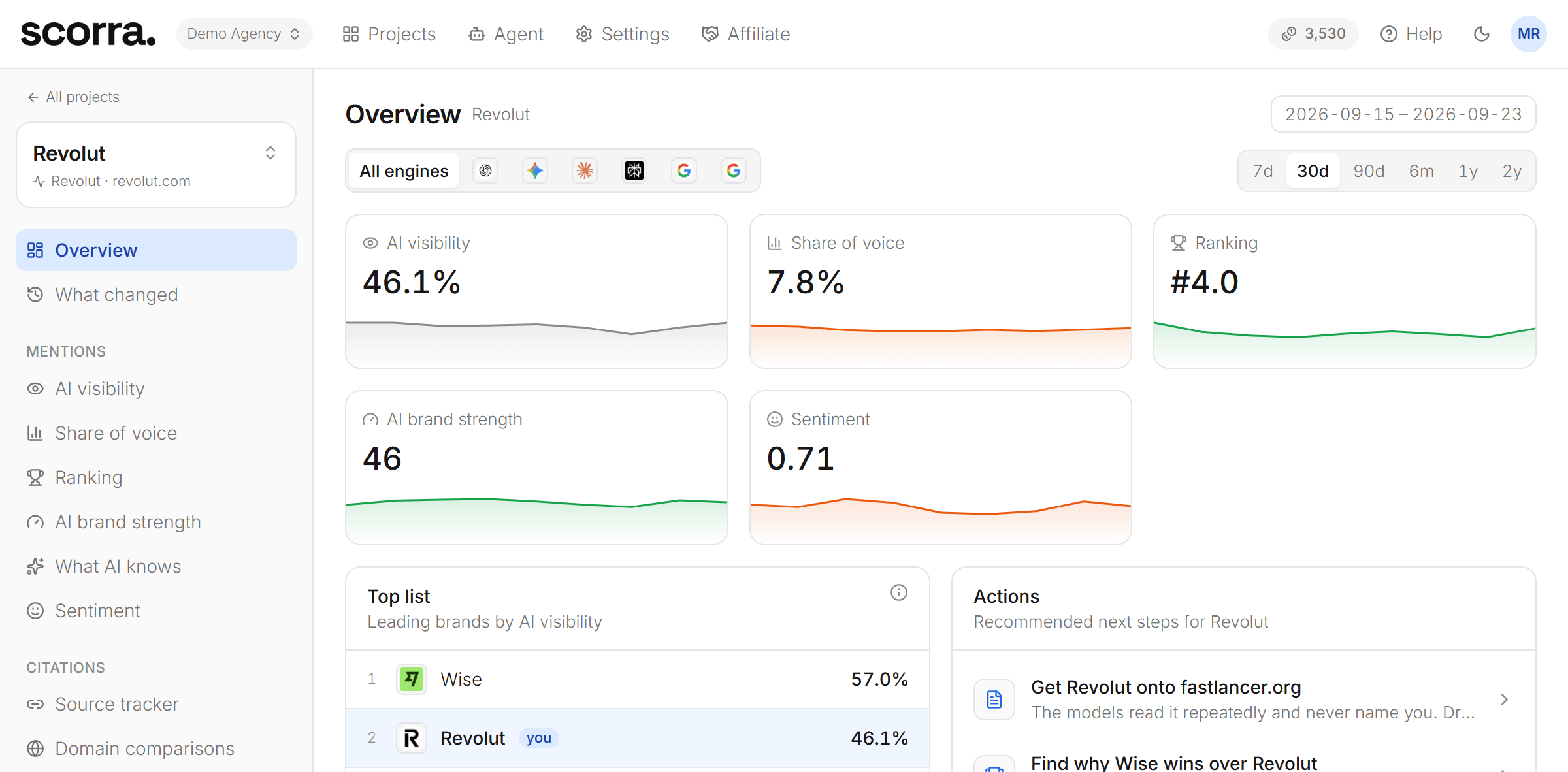
The questions your buyers ask, every day
The same questions, asked on ChatGPT, Gemini, Perplexity, Google AI Mode and Google AI Overviews every day - visibility, position, sentiment and the sources behind every answer.
See which answers you are missing
Enter your domain. We ask the assistants the questions your buyers ask and show where you appear - no account needed.