

Citation analytics: see what AI reads before it answers
An assistant repeats what its sources say. Scorra records every domain and page cited in every answer, classifies each one by source type and content type, and shows which of your questions depend on it — and which sources keep turning up in answers that never name you.
7-day trial. Cancel before day 7 and nothing is charged.
Every domain and page the models cite
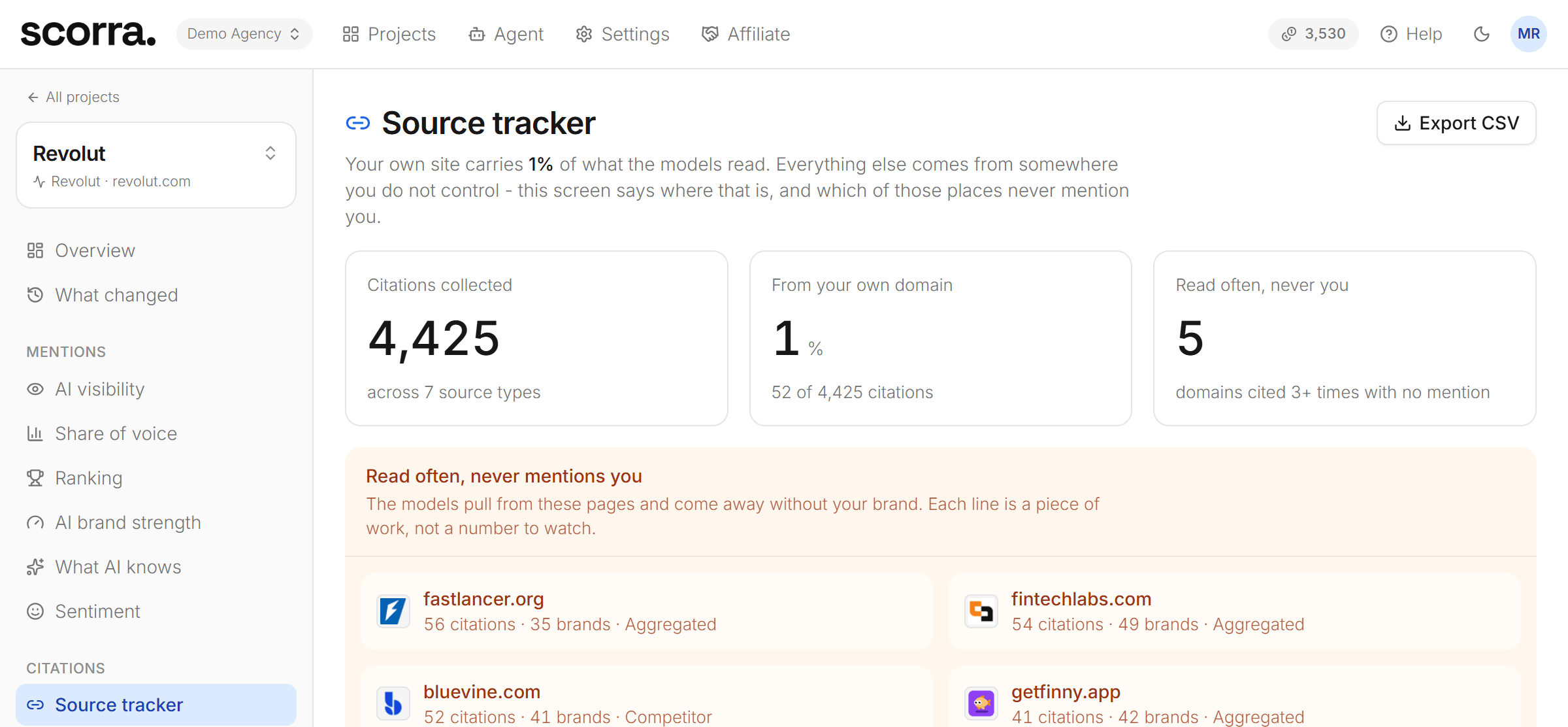
URL-level citation tracking (source tracking): every cited domain and page, its share of all citations, how many brands the answers citing it name, and how often those answers name you. Sort by any column, filter by topic, export to CSV.
What you get: You stop guessing which publications matter: the list shows exactly which pages shape the answers in your category, ranked by how much the assistants rely on them.
Know which kind of source wins your category
Every domain is classified as owned, competitor, earned (press and independent blogs), aggregated (rankings, comparison portals, directories), industry, social or other — and every page as a listicle, comparison, guide, review, product page, landing page, news or video. The split tells you whether to fix your own pages, pitch editors, or get onto the lists.
What you get: Your budget goes to the channel that actually feeds the answers — PR, review sites, communities or your own pages — instead of being spread evenly across all of them.
Read often, never you
Citation gap analysis: the sources cited again and again in answers that do not name you, and the most crowded ones, where the answers name the most rival brands. That list is usually the shortest route from invisible to named.
What you get: A ready-made outreach list: the publications to pitch first, because assistants already trust them and the answers built on them already name your competitors.
Size the prize before you chase it
Source influence for every citation: the tracked questions that pull from a source and the assistants it reaches. A placement that feeds one question is a nice-to-have; one that feeds eleven is next quarter's plan.
What you get: You can put a number on a placement before you pay for it or spend a month pitching it, and defend the choice to whoever signs off the budget.
The ones you can actually get into
Placement opportunities: cited domains where a sponsored publication can be bought through our partner, with the price next to the domain — so the decision is a number, not a guess.
What you get: Shorter budget conversations: every option arrives with the domain, the questions it feeds and what it costs.
- RECORDED
- Domains and individual pages, per answer
- GROUPED BY
- Seven source categories and eight content types
- ANSWERS
- Which of your questions each source feeds, on which assistants
- GAP
- Measured on the answer that cites the source, not by scanning the page
- EXPORT
- CSV on every plan; Looker Studio connector, MCP and API from Growth up
- ALSO CALLED
- citation analytics, citation tracking, source tracking, cited sources, citation intelligence, URL-level citations, domain citations, citation gap, source gap, competitor citation gap, gap analysis, outreach targets
Going deeper: Sources and citations in the documentation.
The rest of the product
- Know whether assistants name you at allAI visibility tracking — also called AI search monitoring or LLM brand tracking. Every day we ask up to 6 assistants the questions your buyers ask, and record which brands the answers recommend — yours, and the ones named instead.
- Find out whether they can read you at allA brand can be invisible for two very different reasons: nobody writes about it, or nobody can read it. The audit tells you which one you have before you spend money on the wrong fix.
- The part that does the workMeasurement tells you that you are missing from the answers. The AI agent — an AI marketer working on your own data — researches the sources behind them, writes the article or the outreach email, and puts the result where your team works.
Find out what they are saying today
Enter your domain for a free scan, or start the trial and watch the trend instead of one measurement.
No account and no card. Or start free trial. 7-day trial. Cancel before day 7 and nothing is charged.